Published
Outcome
A focused path from launch to sustainable app growth
Category
Product
Product
What to Do After Launching an App: A 90-Day Growth Plan
Written by
Ella S.


You built the app, shipped it, and watched the first users arrive. Then the launch spike slowed down—and the harder question appeared: what do you do after launching an app?
The short answer is that you stop treating the app like a finished project and start managing it like a living product. The first 90 days after launch are not about adding every feature users request or spending aggressively on acquisition. They are about learning where the product creates value, where people get stuck, and which improvements can turn early interest into repeat use.
This post-launch app strategy gives founders and product teams a practical order of operations: stabilize the experience, measure the right behavior, improve activation and retention, run focused experiments, and scale only when the product is ready.
Launch Is the Start of Product Development
Before launch, most decisions are based on research, prototypes, usability tests, and informed assumptions. After launch, real behavior becomes available. You can finally see which acquisition channels bring qualified users, whether onboarding leads to a meaningful first outcome, which features become habits, and where people leave.
That shift matters. A roadmap based on opinions usually grows longer and more expensive. A roadmap based on evidence becomes narrower and more valuable. Your job after launch is not to keep the team busy. It is to reduce uncertainty about the product and the market.
A launch gives you users. A post-launch system turns their behavior into better product decisions.
Phase 1: Stabilize the App in the First Two Weeks
Fix failures in the core journey first
Start with the path that delivers the product’s primary value. For a finance app, that may be account creation, connecting data, and viewing the first useful insight. For a marketplace, it may be search, trust, booking, and payment. For a SaaS product, it may be onboarding, setup, and completing the first key task.
Monitor crashes, failed requests, slow screens, payment errors, broken notifications, and support messages. Rank issues by their impact on the core journey rather than by how visible or technically interesting they are. A small defect that blocks activation deserves attention before a polished feature used by a minority of customers.
Create one place for feedback
Early feedback often arrives through email, chat, app-store reviews, sales calls, and personal messages. Collect it in one system and label each item by user segment, journey stage, severity, and frequency. Keep the user’s original language: it often reveals better positioning and interface copy than an internal summary.
Do not turn every comment into a feature. One request is a clue; a repeated pattern connected to observed behavior is evidence.
Phase 2: Set Up Product Analytics That Answer Real Questions
Post-launch product analytics should help the team make decisions, not generate impressive dashboards. Start with a short measurement plan tied to the app’s value proposition.
Define the activation event
Activation is the moment a new user experiences meaningful value—not simply when they create an account. Define the action or short sequence that signals, “This person understood the product and received the promised outcome.” Then measure the percentage of new users who reach it and the time it takes them to get there.
Track a focused set of app growth metrics
For most early-stage apps, the useful starting set includes:
Activation rate: how many new users reach the first-value moment.
Time to value: how quickly they reach it.
Retention by cohort: whether users return after installation or sign-up.
Core feature adoption: which valuable behaviors become repeated behaviors.
Conversion: how users move from free intent to a paid or otherwise valuable action.
Qualitative feedback: why the numbers move.
Retention should be reviewed by cohort, channel, platform, user segment, and app version. A blended average can hide the fact that one audience loves the product while another installs it for the wrong reason.

Phase 3: Improve Onboarding and Activation
If users do not reach value during the first session, buying more traffic will mostly buy more abandonment. Before investing heavily in user acquisition, improve the experience between install and activation.
Remove steps that do not create trust or value
Review every permission request, form field, tutorial screen, and setup decision. Ask whether it is necessary before the user receives their first useful outcome. Move nonessential profile completion and preference settings later. Explain why sensitive access is needed at the moment it becomes relevant.
Design onboarding around an outcome
A feature tour explains the interface. Outcome-based onboarding helps the user complete something meaningful. Use progressive guidance, strong defaults, sample data, contextual prompts, and clear empty states. The experience should demonstrate the app’s value faster than a user could understand it from documentation.
Watch real sessions and speak with users who did not activate. Analytics can reveal where a drop-off occurs; interviews and usability testing explain why.
Phase 4: Build Retention Before Scaling Acquisition
Downloads measure distribution. Retention measures whether the product deserves continued attention. Sustainable app growth starts when a meaningful group of users repeatedly returns for the core value.
Identify the natural usage rhythm
Not every healthy product should be opened daily. A budgeting app, travel-planning product, medical tool, and B2B workflow have different natural frequencies. Define retention around the real job the app performs instead of forcing a daily-active-user metric onto every business model.
Strengthen the core loop
A core loop connects a trigger, a valuable action, a rewarding outcome, and a reason to return. Improve that loop before adding unrelated features. Useful interventions might include saved progress, relevant reminders, collaboration, personalized results, fresh content, or a clearer next step after task completion.
Push notifications and lifecycle emails can support retention, but they cannot manufacture value. Every message should be timely, specific, and connected to a user’s behavior—not a generic request to reopen the app.
Phase 5: Turn the Roadmap into Small Experiments
Once the app is stable and the main funnel is measurable, replace large speculative releases with focused product experiments. Each experiment should include a problem, a target segment, a hypothesis, a change, a success metric, and a review date.
For example: “New users who skip account connection fail to see value. If we provide a realistic preview before asking them to connect data, more users will complete setup within the first session.” This is easier to evaluate than a vague roadmap item such as “redesign onboarding.”
Use an evidence-based priority order
Critical reliability and trust issues.
Friction before the activation moment.
Patterns linked to churn or failed conversion.
Improvements to the core value loop.
New features supported by repeated evidence.
This order protects the team from a common post-launch mistake: expanding the product while its essential experience is still leaking users.
Phase 6: Build a Repeatable App Growth System
When activation and retention improve, begin testing acquisition channels in controlled increments. App store optimization, educational content, founder-led distribution, partnerships, communities, referrals, paid campaigns, and product-led invitations can all work—but not equally for every product.
Test one clear audience, message, creative angle, and channel at a time. Track what happens after the click or install. The cheapest download is not necessarily the best acquisition source; a smaller channel that brings activated, retained, paying users can be far more valuable.
Align positioning with observed value
Users may value the product for a different reason than the original pitch suggested. Update the app-store listing, landing page, screenshots, onboarding copy, and campaigns to reflect the outcomes that retained users describe. Post-launch marketing becomes stronger when it is built from product evidence rather than pre-launch assumptions.

A Practical 30–60–90 Day Post-Launch Plan
Days 1–30: Observe and stabilize
Resolve critical issues in the core user journey.
Define activation and instrument the essential funnel.
Centralize support, reviews, interviews, and behavioral feedback.
Review onboarding sessions and interview both active and lost users.
Avoid large feature commitments until patterns become visible.
Days 31–60: Improve activation and retention
Remove the largest onboarding bottleneck.
Segment retention by audience, source, platform, and version.
Strengthen the product’s core loop and return trigger.
Run a small number of measurable UX and product experiments.
Update positioning using language from successful users.
Days 61–90: Build repeatable growth
Double down on the experiments that improved meaningful behavior.
Test acquisition channels with small, controlled budgets.
Compare acquisition quality using activation, retention, and conversion.
Set a sustainable release and research rhythm.
Create the next roadmap from evidence collected during the first 90 days.
LenguaHub: Designing an MVP Ready to Grow
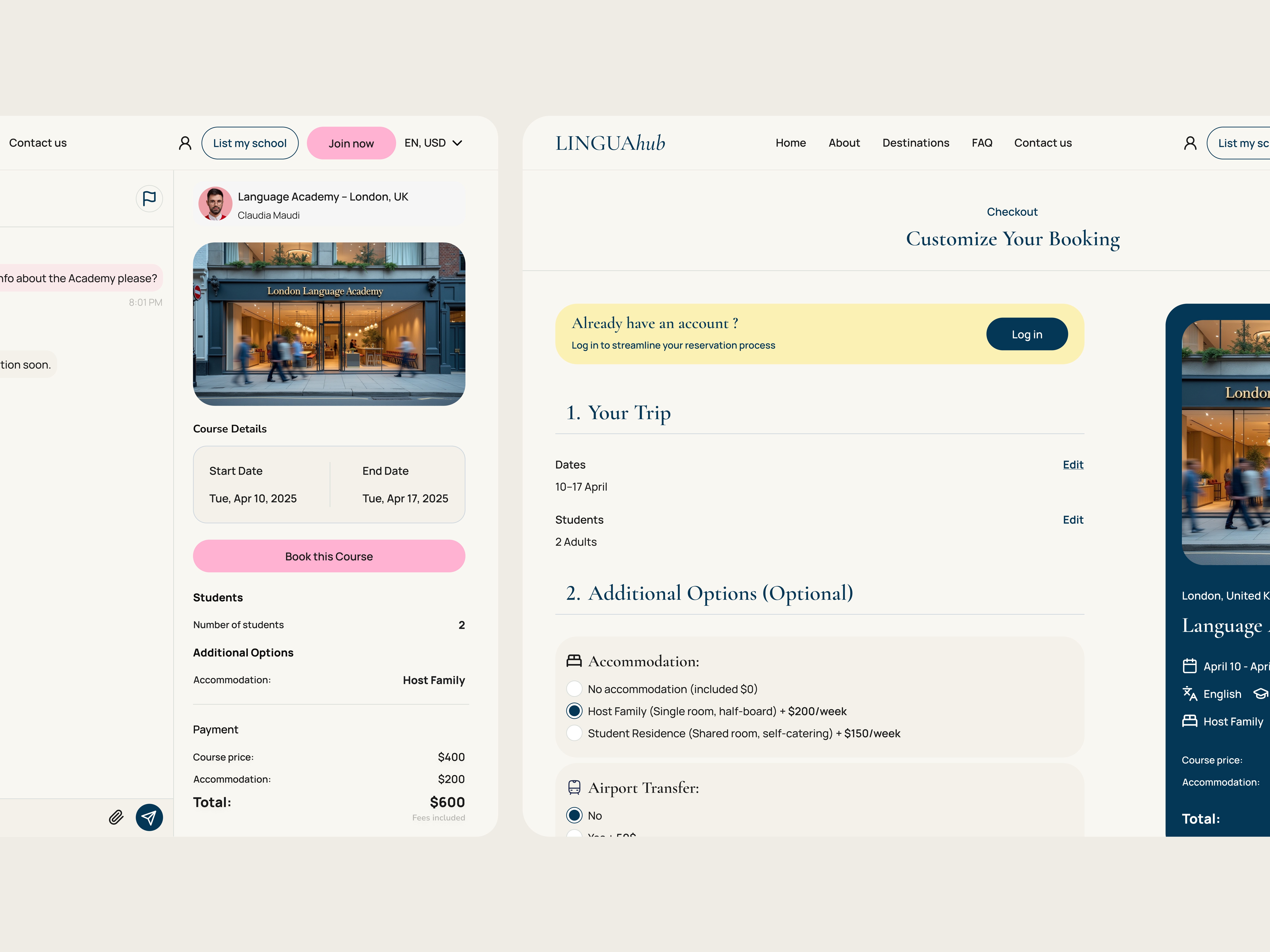
LenguaHub is a language travel marketplace designed to help students discover, compare, and book language programs across international destinations. The product had to connect a broad marketplace proposition with one clear user journey: find a relevant school, understand the offer, build trust, and complete a booking.
For the MVP, The Ash Design created the brand identity and product experience around the highest-value flows: destination and school discovery, filters, detailed academy profiles, social proof, booking configuration, checkout, and direct support. This focused scope gave the team a coherent product to test without trying to build every possible marketplace feature at once.

Designed by The Ash Design for LenguaHub, the project shows what a strong MVP should do: make the core value easy to understand, create enough trust for users to act, and establish a flexible foundation for future destinations, schools, services, and product experiments. Explore the LenguaHub design case study.
Common Post-Launch Mistakes
Building every requested feature. Requests should be understood in context. Often the underlying problem can be solved more simply.
Scaling paid acquisition too early. Marketing amplifies the product you already have, including its friction and weak retention.
Tracking everything without defining decisions. More events do not create more clarity. Every metric should support a product question.
Optimizing for downloads instead of value. Installs matter only when the right users activate, return, and convert.
Treating design as a pre-launch phase. Post-launch UX design is continuous: observing behavior, testing hypotheses, clarifying flows, and evolving the system as the product grows.
From a Finished App to a Growing Product
The best answer to “What should we do after launching an app?” is not a longer feature list. It is a repeatable learning system. Keep the product reliable, understand the first-value moment, improve retention, and run small experiments before making large investments.
The result is more than an app that stays online. It is a product that becomes clearer, more useful, and easier to grow with every release.
Launched an app but unsure what to prioritize next? Book a free product discovery call with The Ash Design to turn early user data into a focused post-launch roadmap.